
05.04.2025
Sobre Thomas Crosse
English epic character/occultist, popularized in Portuguese culture
............................
Numa carta a Ofélia Queiroz em 29-4-1920 Fernando Pessoa refere apenas o «sr. Crosse»; vejamos: «O sr. Crosse mandou antes de ontem uma resposta a concurso, e ontem outra, e hoje vai ainda outra. As duas primeiras são de concursos pequenos, e não há esperança neles. A que vai hoje é de um concurso vulgar, de 250 libras. Uma que deve ir por estes dias é que é de mil libra, ou, antes, para o concurso de mil libras que fecha em 13 de Maio próximo. Há, portanto, tempo.»
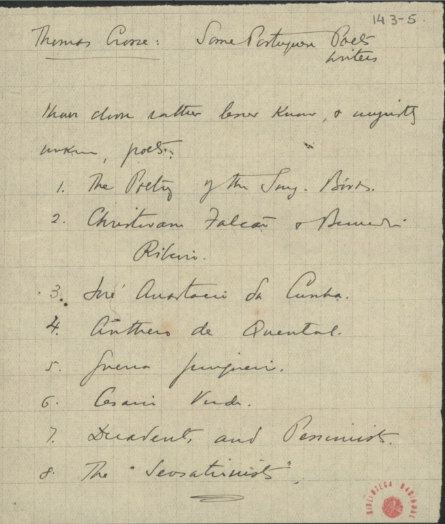
O mesmo Fernando Pessoa através de Thomas Crosse assina um curioso texto intitulado «A semelhança entre o espanhol e o português»: «O inglês é mais complexo e conciso do que o espanhol e o português. Por outro lado, o português tem possibilidades de gamas de significado que são inimagináveis mesmo no inglês. Os portugueses têm, por exemplo, um infinito pessoal. Assim a frase que em inglês não pode ser apresentada em menos palavras do que «I tis enough that we exist» ou «that we be» pode ser dita em português apenas em duas palavras - «Basta sermos». O espólio de Fernando Pessoa na BNP conserva uma charada enviada para um jornal inglês assinada por Thomas Crosse.
............................
The Problem of Languages.
If the possession of a great literature were in itself sufficient to establish, not the mere survival, but the widespread survival of a language, ancient Greek would to-day be the second language of civilization. But even Latin, which was once this, has been able to continue being this. To have a hold on a quantitative future, a language must possess something more than a great literature: the possession of a great literature is an advantage more real than actual, it will save a language from death but will nor promote it to life.
The primary condition for a large hold on a future is, in a language, its natural widespreadness, and this depends on the mere physical fact of the number of people who speak it naturally. The secondary condition is its ease in being learnt; if Greek were easy to learn, we would all have Greek to-day as a second language. The tertiary condition is that the language be as pliant as possible, so that there be in it as full a capacity for expression of all moods as can be, and a consequent capacity to admit, by translation, the reflex of other languages and thus dispense, from the literary standpoint, with the learning of them.
Now, taking not only the present but immediate future, in so far as it may be considered as developing on the embryo conditions of our time, there are only three languages with a popular future — English (which has already a widespread hold), Spanish and Portuguese. They are the languages spoken in America, and in so far as Europe means European civilization, Europe is becoming more and more settled in the Western continent. Such languages as French, German and Italian are never anything but European: they have no imperial power. So long as Europe was the world, they held their own, and even triumphed over the other three, for English was insular and Spanish and Portuguese right at the end. But when the world became the earth, the scene shifted.
It is therefore among these three languages that the future of the future will lie.
by Thomas Crosse
publicado por Tomé Valadares